
The pros and cons
of hydroponic agriculture
— a detailed view
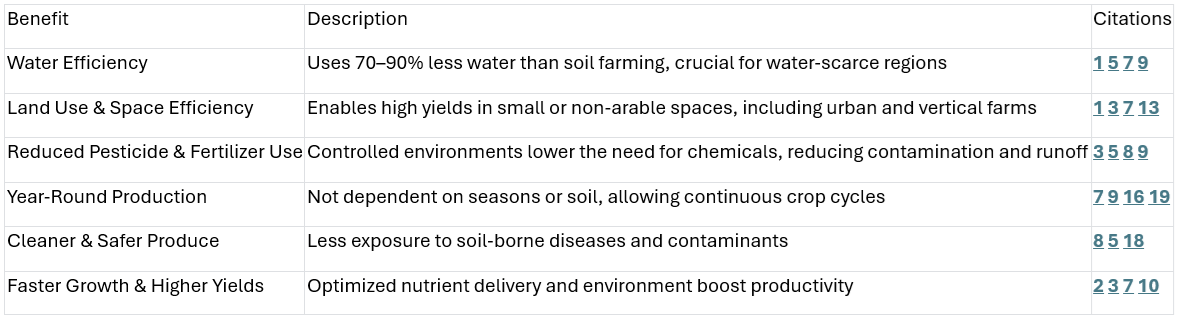
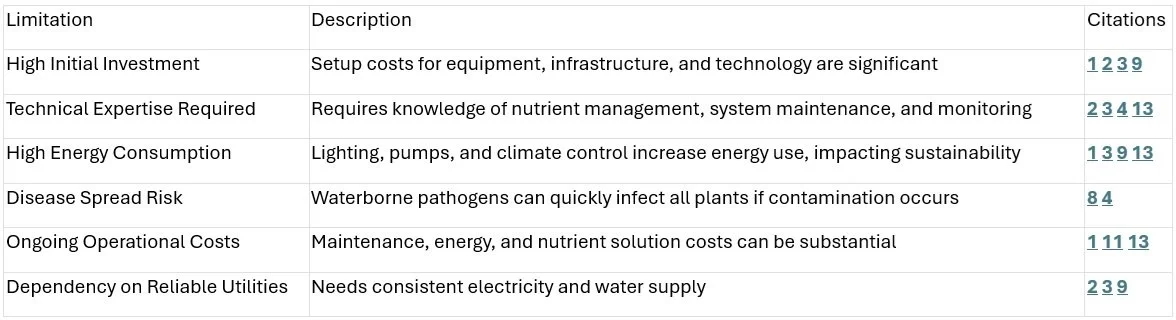
Hydroponic agriculture is a soilless farming method that is increasingly used as an alternative to traditional soil-based agriculture. Its main advantages are efficient resource use, higher yields, and suitability for urban and degraded environments, but it comes with high initial costs, technical demands, and energy requirements.
Key Advantages
Main Disadvantages
Our review of the literature has been filtered for salience, currency and citation rank. In other words, the following scientific papers are at the cutting edge of the topic of whether or not hydroponic farming is a good thing or a bad thing, and why.
Conclusion
Hydroponic agriculture offers major benefits in water and land efficiency, yield, and sustainability, especially for urban and resource-limited settings. However, high costs, technical complexity, and energy demands remain significant barriers to widespread adoption. Careful planning and technological advances are key to maximizing its potential.
With regards the disadvantages of hydroponic farming as detailed above, we can provide consulting to help you mitigate against these risks. We have experience in managing the risks and avoiding losses associated with the risks detailed above.
Citations
1 A Review of Hydroponics and Conventional Agriculture Based on Energy and Water Consumption, Environmental Impact, and Land Use
Hydroponics has advantages such as zero-soil cultivation, land-use efficiency, planting environment cleanliness, fertilizer and resource saving, water consumption reduction, and conservation.
2023·Dimitra I. Pomoniet al.·Energies
2 Hydroponic Farming
Hydroponic farming has potential to produce higher yields, grow crops in poor soil quality, and reduce water and pesticide use.
2023·V. -et al.·International Journal For Multidisciplinary Research
3 Hydroponics: Advantages & Challenges in Soilless Farming
Hydroponics offers effective resource management, increased yields, and lower pesticide use, but is limited by initial setup costs, technological difficulties, and large energy requirements.
2024·Lokendra Khatriet al.· Big Data in Agriculture
4 Hydroponic Solutions for Soilless Production Systems: Issues and Opportunities in a Smart Agriculture Perspective
Hydroponic solutions in soilless cropping systems ensure optimal nutrient acquisition and can be used in areas with severe soil degradation and limited water availability.
2019·P. Samboet al.·Frontiers in Plant Science
5 Hydroponic farming – A state of art for the future agriculture
Hydroponic farming is beneficial in areas with severe soil degradation and limited water availability, as it reduces water requirements by 70-80% and is eco-friendly.
2022·M. Kannanet al.·Materials Today: Proceedings
6 A review on hydroponic greenhouse cultivation for sustainable agriculture.
Hydroponic greenhouse cultivation is a better option for utilization of inputs and improved crop production.
2018·F. Khan
7 Hydroponics: Exploring innovative sustainable technologies and applications across crop production, with Emphasis on potato mini-tuber cultivation
Hydroponics reduces dependency on agricultural land, pesticides, and can be implemented in areas with poor soil quality, mitigating the negative effects of extreme weather events.
2024·Sasireka Rajendranet al.·Heliyon
8 Hydroponic Agriculture and Microbial Safety of Vegetables: Promises, Challenges, and Solutions
Hydroponic agriculture allows for high production yields throughout the year with less water and agro-chemical inputs, but does not guarantee plant health or microbial safety of fresh produce.
2023·Shlomo Sela Saldingeret al.·Horticulturae
9 Revolutionizing Agriculture: Exploring the Potential of Hydroponics for Global Food Security
Hydroponics can be an effective alternate for growing plants without soil, achieving year-round crop production and reducing environmental dependency, but its potential is limited by upfront expenses, technical requirements, and energy use.
2025·Udhav Dahiyaet al.·European Journal of Nutrition & Food Safety
10 Application of Hydroponic System
Hydroponics allows for more efficient use of resources, faster growth rates, and higher yields, while allowing for precise control over growing conditions.
2024·Bijay Thapaet al.·KEC Journal of Science and Engineering
11 Human-powered hydroponic systems: An environmental and economic assessment
Human-powered hydroponic systems can reduce environmental impact of lettuce production, but require higher yields and longer lifespans for economic viability.
2024·Jose L. Casamayoret al.·Sustainable Production and Consumption
12 A Review on Hydroponics and the Technologies Associated for Medium- and Small-Scale Operations
Hydroponics offers a viable alternative to soil-based farming for urban and suburban settings, but requires advanced technologies for successful implementation.
2022·R. Velazquez-Gonzalezet al.·Agriculture
13 A Review on Hydroponics and Vertical Farming for Vegetable Cultivation: Innovations and Challenges
Hydroponics and vertical farming offer sustainable, efficient solutions for urban and peri-urban agriculture, but face challenges like initial investment, energy-intensive operations, and specialized expertise.
2024·Subhash Vermaet al.·Journal of Experimental Agriculture International
14 Hydroponics with wastewater: a review of trends and opportunities
Hydroponics can effectively use reclaimed water as a nutrient solution, potentially making it economically viable for vertical farming and legal cannabis production.
2020·Liliana Cifuentes‐Torreset al.·Water and Environment Journal
15 Bioponics as a Promising Approach to Sustainable Agriculture: A Review of the Main Methods for Producing Organic Nutrient Solution for Hydroponics
Bioponics, a sustainable hydroponics technique, can produce nutrient solutions from local organic materials, offering advantages in nutrient and water use efficiency, pest management, and space use.
2022·I. Szekelyet al.·Water
16 Hydroponics: An Intensified Agriculture Practice to Improve Food Production
Hydroponics techniques offer year-round production, enhanced yields, quality, and environmental benefits, helping to address global food security challenges.
2022·Sowmya Ranganathapura Sathyanarayanaet al.·Reviews in Agricultural Science
17 The Potential of Hydroponic Farming as A Sustainable Alternative to Traditional Agriculture: A Quantitative Investigation
Hydroponic farming, which replaces soil with nutrient-rich water, is a more sustainable and cost-effective alternative to traditional agriculture, offering nutrient-dense food for the global population.
2023·European Journal of Molecular & Clinical Medicine
18 Hydroponics, Aeroponic and Aquaponic as Compared with Conventional Farming
Hydroponics, aeroponics, and aquaponics offer sustainable alternatives to conventional farming, requiring less water, less fertilizer, and less space while increasing yield per unit area and reducing agrichemical use.
2017·Ali AlShrouf·American Scientific Research Journal for Engineering, Technology, and Sciences
19 Hydroponics agriculture as a modern agriculture technique
Hydroponic cultivation yields high-quality crops with 90% more efficient use of water compared to traditional agriculture, making it a promising future for agriculture.
2023·K. Monishaet al.·Journal of Achievements in Materials and Manufacturing Engineering